
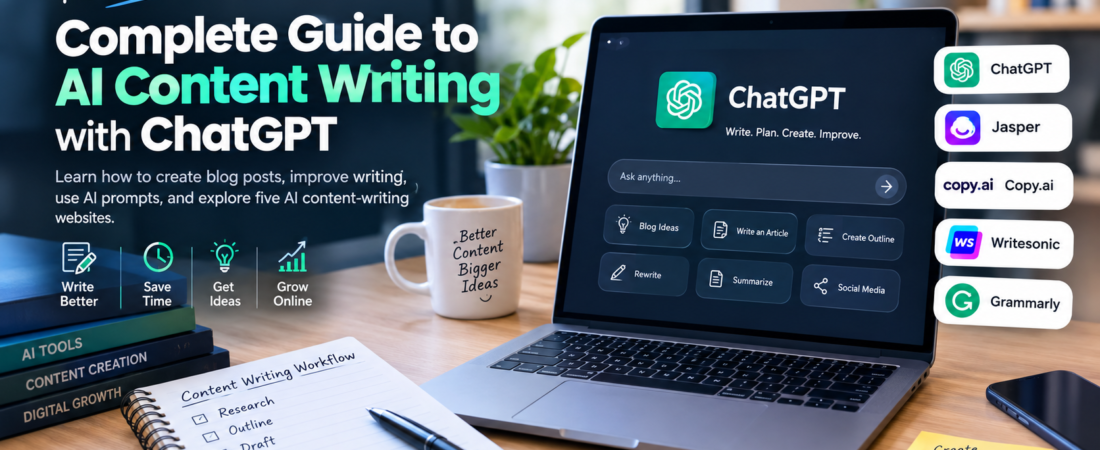
Artificial intelligence is changing the way people create content. From blog posts and website articles to social media captions, marketing emails, and video scripts, AI writing tools are helping people develop ideas and improve their content creation process.
One of the most popular AI assistants for writing is ChatGPT. It can help beginners, bloggers, students, marketers, business owners, and professional writers with a wide range of content-related tasks.
But how does ChatGPT work as a content generator? How can you use it to write better blog posts? Which other AI content-writing websites are worth exploring?
In this guide, Karan Bhatti explains how ChatGPT can support content creation, how to write effective AI prompts, and five AI content-writing websites that can help you explore different writing workflows.
Whether you are starting a blog, managing a business website, creating social media content, or learning about AI tools, this guide will help you understand the practical uses of AI for writing.
What Is ChatGPT?
ChatGPT is an artificial intelligence assistant developed by OpenAI. It allows users to interact with AI through natural-language conversations.
You can ask ChatGPT questions, provide instructions, share text, and request help with different tasks.
For content writers, ChatGPT can act as a writing assistant. It can help with brainstorming, planning, drafting, rewriting, summarizing, and editing.
Some common content-writing tasks include:
- Generating blog post ideas.
- Creating article outlines.
- Writing first drafts.
- Improving grammar and readability.
- Rewriting paragraphs.
- Creating social media captions.
- Writing email drafts.
- Preparing video scripts.
- Creating product descriptions.
- Summarizing information.
- Developing content calendars.
ChatGPT is not a replacement for human creativity or judgment. Instead, it can help you work through the writing process more efficiently.
Why Is AI Content Writing Becoming Popular?
Writing useful content takes time and effort.
A typical blog post may require topic research, planning, outlining, drafting, editing, fact-checking, and formatting. AI tools can assist with several of these steps.
Faster brainstorming
Sometimes the hardest part of writing is deciding what to write.
AI can suggest topic ideas, questions, headlines, and different content angles based on your subject.
For example, if your website focuses on artificial intelligence, you can ask ChatGPT for blog topics about AI tools, automation, productivity, and content creation.
Easier content planning
An outline helps organize an article before you start writing.
ChatGPT can suggest headings and subheadings, allowing you to decide which information should appear in each section.
Support for first drafts
AI can help create an initial draft that you can then edit, improve, and personalize.
This can be useful when you have a clear topic but are struggling to begin.
Improved readability
You can ask ChatGPT to simplify complex sentences, correct grammar, remove repetition, or adjust the tone of existing writing.
More content ideas
AI can help you repurpose one article into multiple content formats, such as social media posts, email newsletters, short scripts, and FAQs.
The key is to use AI to support a useful content strategy rather than producing large amounts of generic text.
How to Use ChatGPT for Content Writing
Here is a simple step-by-step workflow for creating content with ChatGPT.
Step 1: Choose a clear topic
Start with a specific subject.
For example:
How to Use AI Tools for Blog Writing
A specific topic makes it easier to create relevant content.
Instead of asking ChatGPT to write about “technology,” you could ask it to explain “How beginners can use AI tools to create a blog outline.”
The second topic gives the writing a clearer direction.
Step 2: Define your audience
Tell ChatGPT who will read the article.
Your audience might be:
- Beginners.
- Bloggers.
- Students.
- Small business owners.
- Digital marketers.
- Content creators.
- Technology professionals.
For example:
Write for beginners who have never used AI content-writing tools. Use simple English and explain technical terms clearly.
This helps make the article more appropriate for your readers.
Step 3: Ask for an outline
Before generating a complete article, ask ChatGPT to create a detailed outline.
Example prompt:
Create a detailed outline for a blog post titled “How to Use ChatGPT for Content Writing.” The target audience is beginners. Include an introduction, H2 headings, H3 subheadings, practical examples, common mistakes, FAQs, and a conclusion. Make the outline useful and avoid repetitive sections.
Review the outline and change anything that does not fit your topic.
Step 4: Generate a first draft
Once your outline is ready, you can ask ChatGPT to develop the article.
Example prompt:
Write a beginner-friendly blog post about how ChatGPT can help with content writing. Explain its uses, benefits, limitations, and practical prompts. Use clear headings, short paragraphs, and original examples. Keep the tone professional and informative.
You can also specify a target word count, but remember that a longer article is not automatically a better article.
A useful blog post should answer the reader’s questions and provide practical information.
Step 5: Improve the content
After generating a draft, review it carefully.
Ask yourself:
- Does the article answer the main question?
- Is the information accurate?
- Are the examples useful?
- Does the writing sound natural?
- Are any sections repetitive?
- Can I add my own experience?
- Does the article offer something valuable to readers?
You can then ask ChatGPT to improve individual paragraphs.
Example prompt:
Rewrite this paragraph in clear, natural English. Keep the meaning, remove repetition, and make it easier for beginners to understand.
Step 6: Fact-check the article
AI can sometimes generate incorrect information or outdated details.
This is especially important when writing about AI tools because features, pricing, availability, and capabilities can change.
Before publishing, verify important claims using official sources.
For example, if you write about ChatGPT features, check OpenAI’s official website.
If you write about another AI tool, visit that company’s official website to confirm its current features.
Step 7: Prepare the article for SEO
Once your content is ready, you can optimize it for search engines.
Important elements include:
SEO title: A clear title that describes the topic.
Meta description: A short summary that encourages relevant readers to visit your page.
URL: A simple and descriptive web address.
Headings: Use H1 for the main title and H2/H3 for sections.
Internal links: Link to other useful pages on your website.
Images: Add relevant images with descriptive ALT text.
FAQs: Answer common questions related to the topic.
SEO should support the reader’s experience. Avoid repeating keywords unnaturally or creating content solely to manipulate search rankings.
Best ChatGPT Prompts for Content Writing
Prompts are instructions you provide to an AI tool.
A clear prompt can help you communicate what you want the AI to do.
Here are some useful prompts for bloggers and content creators.
1. Blog topic ideas
Suggest 20 useful blog topics about artificial intelligence for beginners. Focus on AI tools, practical tutorials, productivity, and content creation. Include a short description for each topic.
2. Blog outline
Create a detailed SEO-friendly outline for a 1,500-word article about AI content writing. Include an introduction, main sections, practical examples, FAQs, and a conclusion. Avoid keyword stuffing.
3. Blog introduction
Write an engaging introduction for a blog post about how ChatGPT can help with content writing. Use simple English, explain the problem readers face, and introduce the solution.
4. Social media captions
Create five LinkedIn posts based on this blog article. Use a professional and informative tone. Each post should have a clear takeaway and avoid unsupported claims.
5. Grammar improvement
Review the following article for grammar, clarity, readability, and repetition. Suggest improvements while preserving the original meaning and important details.
6. Content calendar
Create a 30-day content calendar for an AI and technology blog. Include article topics, target audiences, search intent, and a suggested content format.
These prompts can be adapted for different industries and content types.
Five AI Content-Writing Websites You Should Know
ChatGPT is not the only AI writing tool available.
Different websites offer different approaches to content creation. Some focus on general AI assistance, while others are designed for marketing, SEO, editing, or business content.
Here are five websites worth exploring.
1. ChatGPT – AI Writing Assistant
Website: https://chatgpt.com/
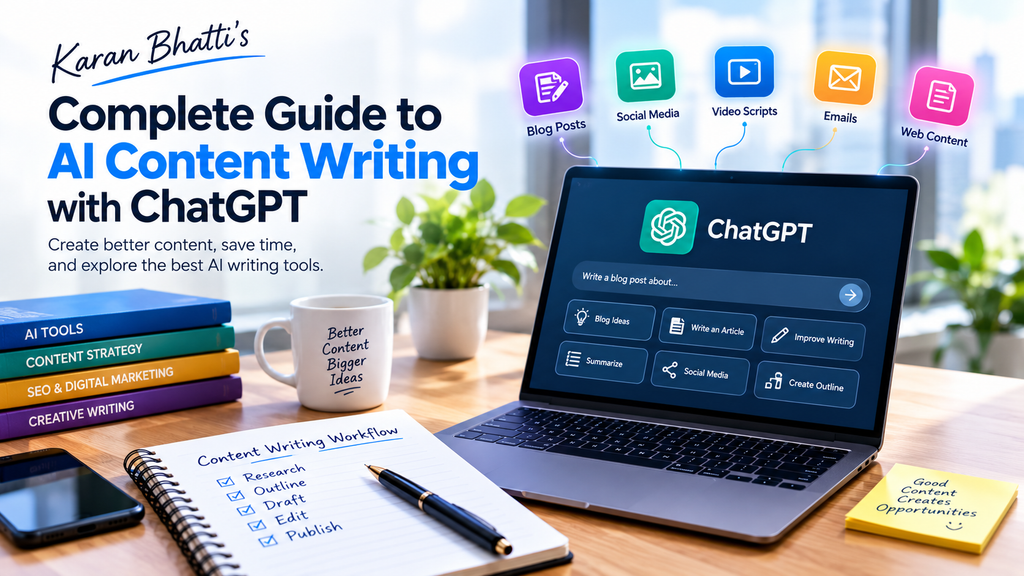
ChatGPT is a general-purpose AI assistant that can help with many writing tasks.
It is useful for people who want to brainstorm, plan, draft, rewrite, and improve content through conversation.
What can you use it for?
- Blog writing.
- Content ideas.
- Article outlines.
- Social media posts.
- Email drafts.
- Summaries.
- Writing improvements.
- Brainstorming.
- Research assistance.
Why explore ChatGPT?
ChatGPT can be adapted to different writing situations. You can provide instructions about tone, audience, length, and format.
For example, a beginner can ask for a simple explanation of an AI concept, while a marketer can ask for several versions of a product announcement.
Best for: General AI-assisted writing and content planning.
Official resource: OpenAI Academy – Writing with ChatGPT
2. Jasper AI – AI Content Creation for Marketing
Website: https://www.jasper.ai/
Jasper is an AI platform focused on marketing and business content creation.
It is designed to help teams and marketers develop content for different marketing activities.
Depending on the available features and plan, users can explore AI-assisted writing, campaign content, brand-related workflows, and marketing copy.
What can it help with?
- Marketing copy.
- Blog content.
- Advertising ideas.
- Campaign messaging.
- Brand-related content.
- Content planning.
- Marketing workflows.
Why explore Jasper?
Jasper is worth considering if your main goal is marketing content and you want to explore a platform designed around business and brand workflows.
Before choosing a plan, review its current features, pricing, and usage limits.
Best for: Marketing teams and businesses exploring AI-assisted marketing content.
Website: Jasper AI
3. Copy.ai – AI Writing for Business Workflows
Website: https://www.copy.ai/
Copy.ai is an AI platform focused on content creation and business workflows.
It can be useful for people working on marketing, sales, and other business-related content.
What can it help with?
- Marketing content.
- Sales messaging.
- Email drafts.
- Social media content.
- Content ideas.
- Business writing.
- Workflow-related tasks.
Why explore Copy.ai?
Copy.ai is worth exploring if you want to understand how AI can support business communication and marketing workflows.
For example, a business owner might use AI assistance to develop a first draft of a promotional email or create ideas for a campaign.
As with other AI tools, the output should be reviewed and adapted to your business.
Best for: Business content and marketing workflows.
Website: Copy.ai
4. Writesonic – AI Writing and SEO Content
Website: https://writesonic.com/
Writesonic is an AI content platform that focuses on writing and related content workflows.
It is known for tools aimed at content creation, marketing, and SEO-related tasks.
What can it help with?
- Blog content.
- Article ideas.
- Marketing copy.
- SEO-related content workflows.
- Product descriptions.
- Content improvement.
- AI-assisted writing.
Why explore Writesonic?
Writesonic is worth exploring if you are interested in creating website content and learning how AI writing tools can fit into a content workflow.
For bloggers, it can be useful to compare how different AI platforms approach outlines, drafts, and content editing.
You should still review factual claims, search intent, originality, and readability before publishing.
Best for: Bloggers and marketers exploring AI content workflows.
Website: Writesonic
5. Grammarly – AI Writing and Editing
Website: https://www.grammarly.com/
Grammarly is a writing assistant that helps users improve grammar, clarity, and communication.
It also offers AI-powered writing features, depending on the product and plan.
While many AI content tools focus on generating drafts, Grammarly is especially relevant to the editing stage of content creation.
What can it help with?
- Grammar checking.
- Spelling.
- Sentence clarity.
- Writing tone.
- Rewriting.
- Communication improvement.
- AI-assisted writing.
Why explore Grammarly?
After creating a blog post, you may want to improve sentence structure, fix grammar mistakes, and make the writing easier to read.
Grammarly can be useful as part of that editing process.
It is not a substitute for fact-checking or reviewing the accuracy of an article.
Best for: Editing, proofreading, and improving written communication.
Website: Grammarly
Comparison of Five AI Content-Writing Websites
| AI website | Main focus | Useful for |
|---|---|---|
| ChatGPT | General AI writing assistant | Blog ideas, drafts, prompts, rewriting |
| Jasper | Marketing and business content | Campaigns, brand content, marketing |
| Copy.ai | Business and marketing workflows | Sales and marketing writing |
| Writesonic | AI content and SEO workflows | Blogs, articles, marketing content |
| Grammarly | Writing assistance and editing | Grammar, clarity, rewriting |
This is a general comparison of the platforms’ focus. Features and pricing can change, so visit each official website for current information.
ChatGPT vs Other AI Writing Tools
Many people ask whether ChatGPT is better than other AI content-writing websites.
The answer depends on what you want to accomplish.
If you want a general AI assistant that can help with brainstorming, explanations, drafting, and rewriting, ChatGPT is a useful option to explore.
If you want marketing-focused workflows, you may prefer to investigate platforms such as Jasper or Copy.ai.
If your focus is content production and SEO-related workflows, Writesonic may be worth exploring.
If your primary need is editing and improving writing, Grammarly is relevant.
There is no single AI writing tool that is ideal for every person or every task.
The best way to choose is to compare the features, workflow, ease of use, output quality, and pricing against your own requirements.
Benefits of Using AI for Content Writing
Saves time during planning
AI can help you brainstorm ideas and create an outline more quickly.
Helps overcome writer’s block
When you are unsure how to begin an article, AI can provide possible introductions, headings, and writing directions.
Supports different writing styles
You can ask AI to adjust the tone of content for beginners, professionals, customers, or social media audiences.
Helps with content repurposing
A single article can be adapted into captions, scripts, email ideas, and summaries.
Supports learning
Beginners can use AI to ask questions about writing structure, grammar, content strategy, and technology.
Helps organize information
AI can assist with turning notes and ideas into a structured draft.
These benefits depend on the quality of your instructions and how carefully you review the results.
Limitations of AI Content Generators
AI writing tools are useful, but they also have limitations.
AI can make mistakes
An AI-generated article may contain incorrect facts, outdated information, or invented references.
Always verify important claims before publication.
AI content can sound repetitive
If you use the same prompts repeatedly, your content may become generic.
Add your own examples, experiences, and insights.
AI does not automatically understand your audience
You still need to explain who your readers are and what they need.
AI-generated content needs editing
A first draft is not necessarily a finished article.
Review grammar, accuracy, structure, and tone.
AI does not replace original expertise
Your own knowledge and experience can make an article more useful and distinctive.
Privacy matters
Avoid sharing confidential business information, personal data, passwords, or sensitive documents with an AI tool unless you understand the relevant privacy protections and have permission to do so.
How to Create Better AI Content
Here are some practical tips that can improve your results.
Give specific instructions
Instead of:
Write an article about AI.
Try:
Write a beginner-friendly article explaining how AI writing tools can help small business owners create website content. Include practical examples, benefits, limitations, and a step-by-step workflow.
The second prompt gives the AI a clearer task.
Provide context
Tell the AI about your audience, website topic, writing style, and purpose.
Ask for examples
Examples can make technical concepts easier to understand.
Review every important claim
Especially when writing about technology features, prices, statistics, or professional topics.
Add your own perspective
Your experience and insights can make the content more valuable.
Avoid keyword stuffing
Use keywords naturally and focus on answering the reader’s question.
Keep the reader in mind
Ask whether the article is genuinely useful.
Good content should educate, inform, or solve a problem.
Frequently Asked Questions
Is ChatGPT free for content writing?
ChatGPT has offered free access as well as paid plans. Availability, features, and limits can change. Visit the official ChatGPT website for the current options.
Can ChatGPT write a complete blog post?
Yes, ChatGPT can help generate a complete blog draft. However, you should review, fact-check, edit, and personalize the content before publishing.
Is AI-generated content good for SEO?
AI-assisted content can be useful for SEO when it provides accurate, original, helpful information. Using AI alone does not guarantee search rankings.
Which AI writing tool should beginners try?
Beginners can start by exploring ChatGPT because it supports a wide range of writing tasks. Other tools may be more relevant depending on whether the user focuses on marketing, business workflows, SEO, or editing.
Can AI replace content writers?
AI can assist with many writing tasks, but human writers still provide creativity, judgment, expertise, fact-checking, and editorial decisions.
How do I write better prompts?
Give clear instructions about the topic, audience, goal, tone, format, and important requirements. You can also provide examples of the style you want.
Conclusion
AI content-writing tools are changing how people approach blogging, marketing, and digital communication.
ChatGPT is a useful AI assistant for brainstorming ideas, creating outlines, drafting articles, improving writing, and exploring new content workflows.
Other platforms, including Jasper, Copy.ai, Writesonic, and Grammarly, offer different approaches to AI-assisted writing and editing.
The most important thing to remember is that AI should support your content creation process—not replace your judgment.
A successful content strategy combines useful ideas, accurate information, human editing, and a clear understanding of the audience.
If you are interested in artificial intelligence and want to learn how to use AI tools for everyday work, exploring these platforms can be a practical starting point.
Keep learning, keep experimenting, and use AI responsibly.